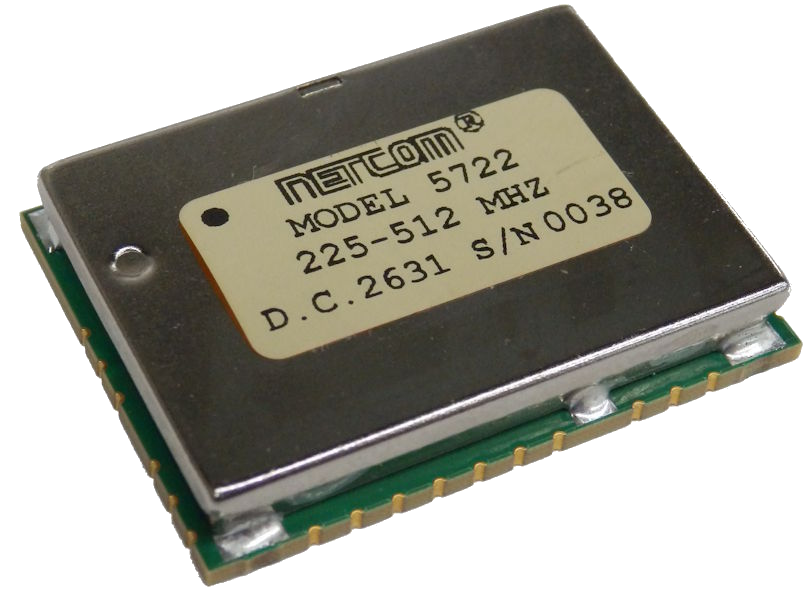
5722 Notch Filter
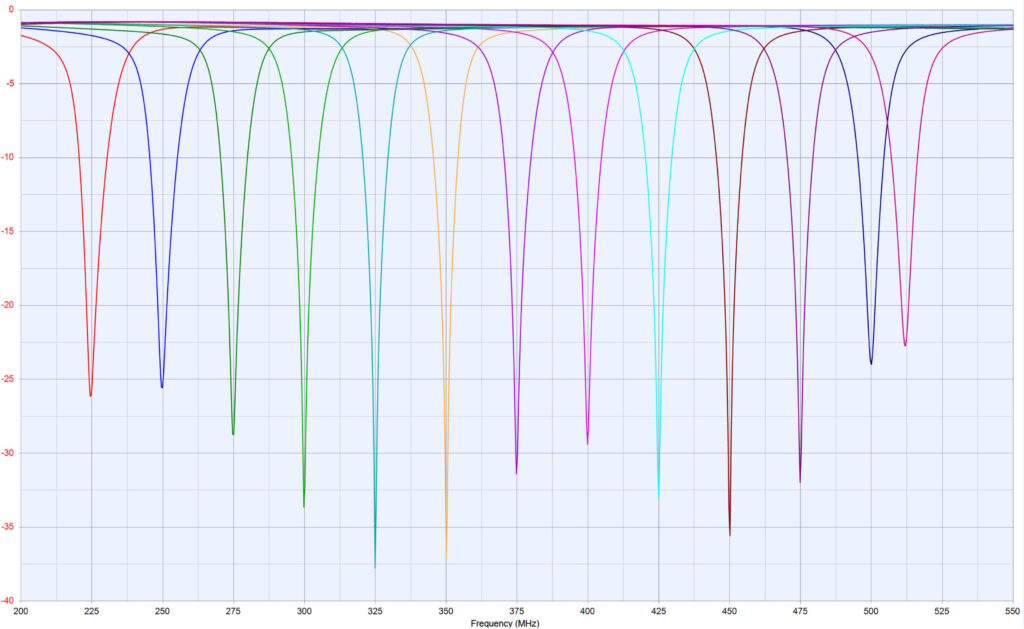
The UHF Tunable Notch filter is designed with lumped elements. The design topology for the filter was selected to achieve constant absolute bandwidth over the 225-512MHz frequency range with minimum insertion loss at the passband and peak notch rejection better than 20dB. It can be programmed to turn on (active mode) or off (bypass mode). The tuning frequency step for each notch is 200 kHz (tuning resolution). The filter is equipped with internal temperature compensation that regulates the Temperature Drift of the Notch Frequency keeping it in spec at all temperature conditions.
- Specifications
- Performance
- Mechanical
- More Details
| Passband Frequency Range | 225 to 512MHz |
| Tunable Notch Frequency Range (fnotch) | 225 to 512MHz |
| Notch Rejection at fnotch±2MHz | 17dB typical, 15dB min |
| Passband Insertion Loss outside fnotch±24MHz | 1.2dB typical |
| Insertion Loss at fnotch±14MHz | 2.8dB typical, 3.4dB max |
| Impedance (Input/Output) | 50 Ω |
| VSWR | 2.5:1 |
| Temperature Range | -40°C to +85°C |
| RF Power Handling | +33dBm |
| IIP3 | +54dBm |
| DC Power | |
| DC Voltage | 3.3 VDC ±0.3 VDC |
| DC Current Max | 60mA |
| Control Interface | SPI Serial Input |
| Tuning Resolution | 200 kHz |
| Switching Speed, 90% RF Power (typical) | < 50μsec |
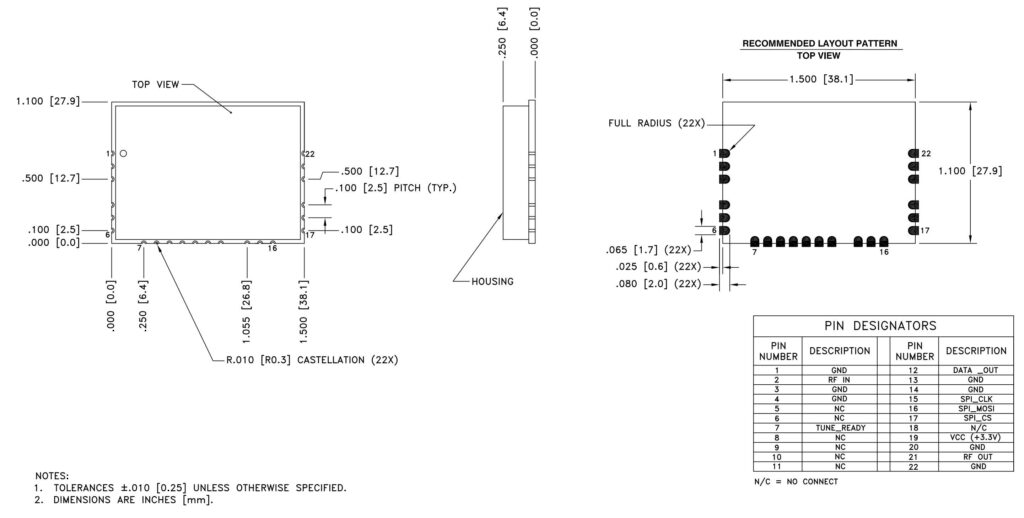
| Dimensions [L x W x H] | 1.50 X 1.10 X 0.25 inches
38.10 X 27.94 X 6.35 mm |
Superimposed plots every 25MHz:
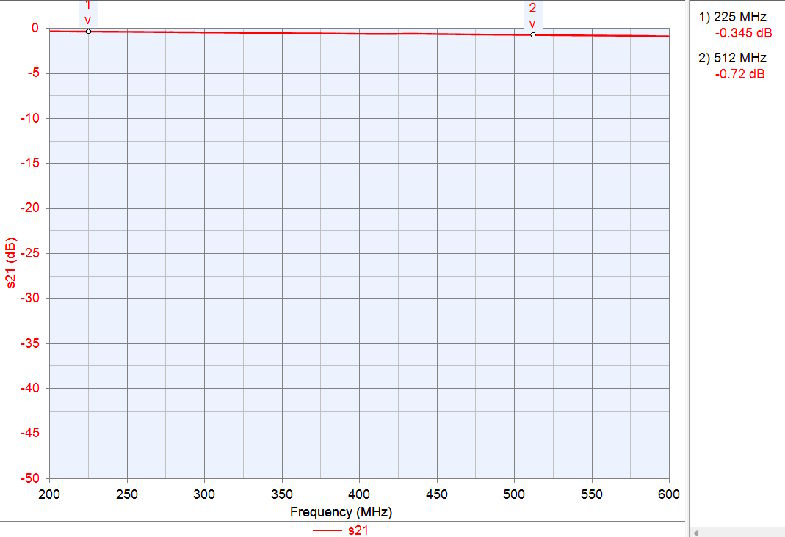
Bypass mode:
Lead Plating:
ELECTROLESS NICKEL, TYPE 1, CLASS 1, Cu/Ni P7, 100 MICRO INCHES (0.0001 INCHES) MINIMUM, IMMERSION GOLD PLATE 2 TO 6 MICRO INCHES (0.000002 TO 0.000006 INCHES) ON OUTER LAYERS.
Temperature:
- High temperature shall meet MIL-STD-810E, Method 501.3, Procedure I to 85°C storage, and procedure II to 85°C operating.
- Low temperature shall meet Method 502.3, Procedure I to -57°C storage, and Procedure II to -40°C operating.
Vibration:
- MIL-STD-810E Method 514.4 Ground Mobile Test Procedure I, Test Condition I – 3.4.7
Shock:
- MIL-STD-810E Procedure I, Method 516.4 – Functional Shock.
Cleaning:
- Recommend cleaning solvents used which meet ODC (Ozone Depleting Chemical) requirements.
- Solvents containing methylene chloride or other epoxy solvents should be avoided since these will attack the epoxy encapsulation material of some components.
- Ultrasonic cleaning not recommended.
Moisture Sensitivity Level:
- MSL 3